Muvicado layout showcase
A muvicado layout is an arrangement of tiles that corresponds to a sequence of musical notes that can be performed easily, expressively, flexibly, and efficiently.
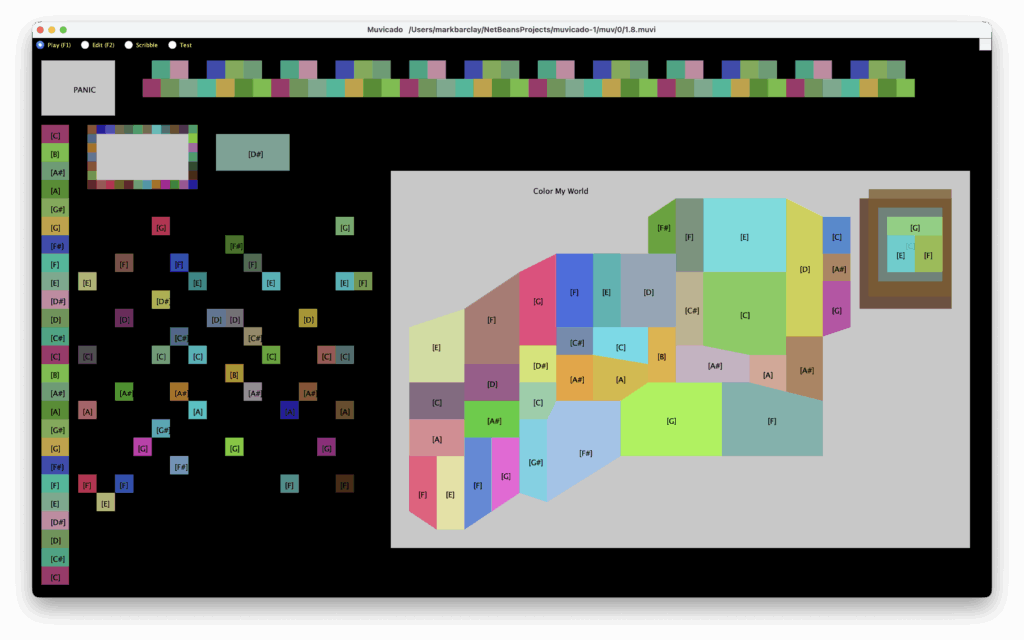
The song “Color My World“ is an example of such a layout. This song, by the classic horn band “Chicago“ from the early 80s I think, is a typical example of a Muvicado layout that illustrates and emphasizes the geometric nature of melody in a two dimensional space.
FACE the Music
The opening “F-A-C-E” (followed by CAFACECA…) was the initial inspiration for employing a visual 2D layout of musical notes for composing, arranging, performing and composing music – the original essence of Muvicado. The song starts with a simple piano arpeggio played in a vertical up/down gesture, moving along the left edge of the play area with the sequence of F, A, C, E – an arpeggiated Fmaj7.
Then, the melody progresses back down from E through C, A, F. Successive bars, with one or two notes changing between bars, progresses through the song from left to right, in roughly aligned columns of pads (for efficient navigation). At the end of the main theme, a “twiddle” is played, resolving to the root scale of Fmaj, ending the song, cycling around a small nested pad arrangement with the root major chord of Fmaj with a “9th” thrown in at the end as a farewell grace note.
The above basically describes the textbook “hello world” of a Muvicado layout.
Next. I’ll tighten this up and make it something that can be used as a reference and for demonstration purposes.
1. Formalizing “Muvicado layout”
Let’s pin this down:
A Muvicado layout is a 2D arrangement of playable tiles (pads, keys, nodes) where:
- A specific song or musical idea traces out simple geometric paths in that space
- Those paths are:
- Performable (ergonomic for hands/fingers)
- Expressive (invites phrasing, dynamics, voicings)
- Flexible (easy to reharmonize / transpose / vary)
- Efficient (minimal awkward jumps; reuse of shapes)
- And the geometry itself exposes or reinforces the underlying harmonic logic of the piece.
So instead of “notes scattered on keys,” you get:
- chords as vertical stacks,
- inversions as small shifts,
- voice leading as small geometric movements,
- fills and “twiddles” as orbits around a home cluster.
That’s Muvicado.
2. “Color My World” as a Muvicado archetype
Let’s look at this in layout terms (no sheet music, just geometry + pitch names):
- Opening vertical gesture Left edge, straight line:
- F – A – C – E → an Fmaj7 stack on a single column.
- As a Muvicado move, that’s:
- “Plant your hand here”
- “This vertical is your home chord + color (maj7).”
- Visually: a tall, elegant column. It teaches the hand the chord.
- Mirror / inversion descent Then you describe:
- moving from E through C – A – F:
- same four chord tones, reversed order.
- Geometrically: a downward traversal of the same column or a flip/inversion path.
- Muvicado-wise:
- This is the concept of shape-preserving motion.
- “You are still inside Fmaj7-land; you’re just re-threading its tones.”
- moving from E through C – A – F:
- Progressing left → right, one bar at a time Key property you called out:
- Successive bars only change one or two notes.
- On a grid, that looks like:
- Each bar = a vertical slice (column group).
- Changes = tiny shifts (one tile over / up / down).
- This is visible voice-leading:
- Harmonies glide.
- The player feels: “stay in the neighborhood; only nudge one finger.”
- That’s what Muvicado is about:
- Efficient.
- Easy to learn.
- Geometrically memorable.
- The “twiddle” + F major + 9th resolution End of the main theme:
- A compact little nested pad cluster: tones of F major plus the 9th (G).
- A small circular or diamond-shaped orbit pattern.
- Final G (9th) as a gentle grace-note goodbye.
- In layout language:
- “Here is your home base motif: a tight cluster you can swirl around.”
- So we’ve encoded:
- tonic,
- color tone (9),
- resolution behavior,
into a tiny local geometry.
“Color My World” behaves like:
- Column (Fmaj7 identity)
- → Local flips/shifts (minimal-move variations)
- → Rightward drift (song form unfolding)
- → Nested home cluster (resolution pad).
It’s an examplke of using a visual pattern language for musical ideas.
3. One concrete way to sketch it…
Here’s a partial illustrative pad map that has been prototyped (not literal to every note; it encodes the concept):
(col 0)     (col 1)     (col 2)     (col 3)
  E           E           E           G
  C           C           D           F
  A           A           A           C
  F           F           F           F
- Col 0: pure F–A–C–E vertical → “Here’s your Fmaj7.”
- Cols 1–2: small tweaks (e.g., D appears, voicings shift) → voice-leading geometry.
- Col 3: tight F–A–C–G cluster → Fadd9 / Fmaj9 “twiddle zone.”
The performer would play:
- mostly vertical + tiny diagonals,
- almost no ugly leaps,
- always “seeing” the harmonic neighborhood.
That’s a Muvicado layout: a performance surface where the song is a clean geometric walk.
4. This is central to Muvicado as a platform
“Color My World” is my first example of a “visual musical story”:
- It shows that:
- A well-designed grid can encode a whole tune as a shape, not just as pitches.
- Beginners can literally trace the path.
- Advanced players can decorate inside the same geometry (altered extensions, reharm, rhythmic variation) without getting lost.
- We can provide an illustrative demo:
- Show the F–A–C–E column.
- Show tiny bar-to-bar changes.
- Show the end “twiddle cluster.”
- This will illustrate how Muvicado layouts let you design instruments so songs live as shapes.
Next, we’ll derive a generalized rule set: how to detect / construct Muvicado-friendly layouts from any chord progression, turning “Muvicado layout” into a rule set that can be applied to any chord progression.
We’ll split this into two things:
- How to construct a Muvicado-friendly layout from chords.
- How to detect when a layout is Muvicado-friendly.
Hopefully, this can stand-in as a usable spec.
1. Core idea (what we’re optimizing for)
A Muvicado layout is good when a song’s notes form:
- Smooth paths (small moves, repeatable shapes)
- Clear geometry (lines, clusters, orbits you can see and remember)
- Consistent interval vectors (a 3rd, 4th, etc. “feels” like the same move everywhere)
- Ergonomic play (hands don’t jump stupid distances)
- Expressive flexibility (easy to add chord tones, extensions, fills without leaving the local geometry)
We’re encoding music as navigation on a 2D grid.
So the rule set is basically: given a chord progression + key center, choose a mapping and note layout that makes that navigation beautiful.
2. Construction Rules (from chord progression → layout)
Think of this as a design/algorithm you could implement.
Step 0 — Choose a lattice
Pick a 2D pitch-mapping scheme that’s consistent:
Examples. These may be swapped depending on the instrument (selected by per-pad MIDI channel):
- Vertical = chord tones stacked by 3rds, horizontal = time/sections.
- Or: vertical = scale degree, horizontal = 4ths/5ths.
- Or: one axis = diatonic steps, other axis = chromatic or function.
Rule C0: Whatever you choose, the same interval should correspond to the same geometric move (or small set of moves) everywhere.
Step 1 — Anchor the “home” chord cluster
Given:
- Key center K (e.g., F)
- Primary chord(s) (I, i, or tonic-ish)
Rules:
- Place the tonic chord (e.g., F–A–C–E) as a compact, readable shape:
- Often a vertical or diagonal stack.
- This becomes your Home Column / Home Cluster.
- Ensure:
- Root is easy to hit,
- Color tones (7, 9, 6) are nearby (adjacent tiles, not across the map).
This is the “Color My World” Fmaj7 column generalized.
Step 2 — Layout for voice-leading, not just chords
For each chord change in the progression:
Given:
- Previous chord: Cn
- Next chord: Cn+1
- Shared tones: Cn∩Cn+1
- Moving tones: Cn+1∖Cn
Rules (VL-series):
- VL1: Shared tones should:
- stay on the same tiles if possible,
- or move by 1 step (up/down/diagonal).
- VL2: Moving tones should:
- move by small geometric steps (ideally 1–2 tiles).
- VL3: Avoid mappings where a simple ii–V–I or I–vi–IV–V requires wild zigzags.
In code terms, for each chord transition, we want to minimize total tile-distance of voices.
Step 3 — Bars and sections as columns / lanes
For progressions across time:
- Treat each bar or harmonic event as a vertical slice (or small region).
- Chords in chronological order move left → right (or another consistent direction).
Rules (T-series):
- T1: The main melody path should read as a mostly monotonic path along one axis (e.g., left→right) with gentle vertical/diagonal moves.
- T2: Harmony/voicing for each bar sits close to the previous bar’s voicing:
- At most 1–2 tiles away for most inner voices.
- T3: Repeated sections reuse the same or congruent shapes (so A section feels like a recognizable pattern).
This is what makes the layout “geometric” instead of random.
Step 4 — Twiddle zones and color tones
For fills, runs, and expressive stuff:
Rules (X-series):
- X1: Around each primary chord, define a local neighborhood (e.g. radius-1 or radius-2 tiles) containing:
- scale tones,
- chord extensions (9, 11, 13),
- neighbor tones.
- X2: Ensure twiddles (grace notes, neighbor movements, turns) form small closed loops or arcs:
- visually: tiny orbits, diamonds, triangles.
- X3: The tonic/home twiddle zone should be:
- especially tight and inviting (your “end of Color My World” vibe),
- easy to noodle on without leaving key.
This is how we “bake in” safe improvisation.
Step 5 — Cross-check ergonomics & efficiency
Now let’s treat the pad layout as something to score.
For a given song mapped to a grid view of the notes in a song , compute:
- Path length: sum of distances between successive melody notes.
- Max jump: largest single movement.
- Chord reuse: how many notes stay on same tiles / close tiles between chords.
- Locality: proportion of notes inside local neighborhoods of main clusters.
- Shape coherence: does the path look like a few simple motifs (lines, arcs, orbits)?
Rule E1: A layout is “Muvicado-friendly” if:
- Average step size is small,
- Max jumps are rare,
- Voice leading is visually obvious,
- The song’s main motives are drawable as simple geometric gestures.
(We could later formalize that as a cost function and search for an optimal mapping)
3. Detection Rules (given a layout + tune: is it Muvicado?)
Given:
- A fixed grid layout,
- A mapping from notes → pads,
- A specific chord progression + melody.
Check:
- Interval Consistency
- Same musical intervals correspond to the same or similar geometric moves.
- If a major 3rd is sometimes near, sometimes miles apart, that’s a red flag.
- Voice-Leading Smoothness
- Track each voice (or implied inner voice).
- Are changes between chords:
- mostly 0–1 tile moves? ✔
- often 3+ tiles jumps for no harmonic reason? ✘
- Melodic Path Geometry
- Plot the melody on the grid.
- Does it form:
- lines / arcs / mirrored shapes / small repeated motifs? ✔
- or noisy random scatter? ✘
- Local Neighborhood Richness
- Around tonic and key chords:
- Are chord tones + key scale tones clustered? ✔
- Or weirdly sparse / fragmented? ✘
- Around tonic and key chords:
- Playability
- For two human hands:
- Are most notes within a natural reach span?
- Can common voicings be held without contortion?
- For two human hands:
If a layout scores well on those, we could call it a valid Muvicado layout for that tune.
© 2025 Muvicado Mindware LLC · Design and vision by Mark Barclay